
Field Service Management for Oil and Gas
Oil and gas operations run on assets that can’t afford downtime, and technicians who can’t afford mistakes.
Whether it’s an offshore platform hundreds of kilometers from shore or a pipeline crossing multiple regions, field service management software gives oil and gas companies one system to schedule, dispatch, and support every technician working on mission-critical infrastructure. For over 20 years, oil and gas industry leaders have relied on OverIT to bring upstream, midstream, and downstream field operations onto a single platform, protecting worker safety, cutting response times, and keeping assets running longer.

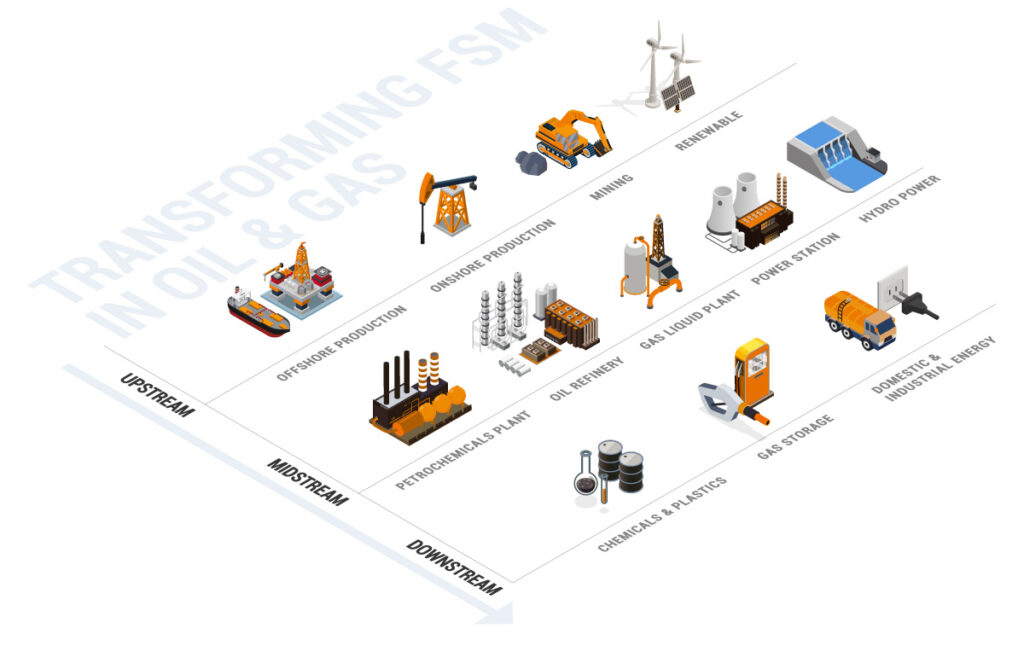
Main processes managed in the Oil and Gas Industry
Oil and gas field service management spans three connected stages of the product lifecycle:
Challenges faced by Oil and Gas companies
Five recurring obstacles make field operations harder to manage at scale:
Worker safety in hazardous environments
Technicians perform maintenance and inspection on high-pressure, high-temperature assets daily, often in hazardous-area conditions that require full asset context and safety protocols before any intervention begins.
A retiring workforce and disappearing institutional knowledge
As experienced technicians retire, companies lose decades of collective know-how, leaving new hires to build expertise on the job without the safety margin that experience used to provide.
Remote sites and limited connectivity
Upstream and offshore operations are frequently far from reliable networks. Technicians often work alone, and getting a second opinion on-site can mean hours of travel or dependence on satellite connectivity that isn’t always dependable.
Coordinating contractors and third-party crews
Oil and gas operators rely heavily on external contractors for specialized maintenance and turnaround work, making it harder to keep one consistent view of who’s on-site, what they’re qualified to do, and what’s actually been completed.
Meeting regulatory and safety compliance demands
Pipeline safety, emissions reporting, and permit-to-work requirements all generate documentation that has to be accurate, current, and audit-ready at any time.
How Field Service Management Software Solves These Challenges
A dedicated field service management platform brings scheduling, dispatch, asset maintenance, and compliance documentation into one system, so oil and gas companies can manage every process above from a single source of truth.
Supporting Sustainability in Oil and Gas Operations
Lower emissions from field travel
Optimized routing and scheduling reduce the miles technicians drive and improve fuel efficiency across upstream, midstream, and downstream operations.
Faster leak detection, fewer environmental incidents
Earlier identification of pipeline and equipment anomalies helps prevent environmental disasters before they escalate.
Paperless field operations
Mobile-first workflows eliminate paper-based processes, supporting the UN Sustainable Development Goals and moving operations toward fully digital, auditable records.
Real-World Results: Oil and Gas Companies Using OverIT

Frequently Asked Questions
How does field service management software support offshore oil and gas operations?
It combines offline-first mobile access with GIS and asset data so technicians can complete inspections, log job status, and access safety documentation even without a live connection, then sync automatically once back online.
Can FSM software help with oil and gas pipeline leak detection?
Yes. OverIT’s platform combines GIS mapping with real-time asset data to flag anomalies along pipelines and route technicians to the right location faster, reducing the time between detection and response.
How does field service software address the retiring oil and gas workforce?
By capturing inspection history, asset documentation, and step-by-step job guidance inside the platform, new technicians can draw on the same institutional knowledge senior staff relied on, without waiting years to build it themselves.
What oil and gas companies use OverIT’s field service management platform?
OverIT works with oil and gas and energy operators including Snam, Saipem, and Drillmec, supporting use cases from remote platform inspections to remote-controlled maintenance activities.
Does OverIT’s FSM software work without internet access on remote sites?
Yes. The FSM platform’s offline mode lets field technicians view maps, asset data, and job details, and complete their work, without a live connection, syncing automatically once connectivity is restored.
How does field service management reduce compliance risk in oil and gas operations?
By digitizing work orders, inspection records, and maintenance history, the platform creates an auditable trail that supports regulatory reporting and safety compliance, replacing manual, paper-based processes that are harder to verify.